
A common question during electrical infrastructure estimating is deceptively simple: if an 11kV/400V transformer and a 22kV/400V transformer are both rated at 100 kVA, why should the 22kV transformer cost more?
The answer is not that the 22kV unit handles twice the power—it does not. Both are 100 kVA machines. The cost difference comes mainly from designing the high-voltage side for a higher system voltage and insulation level. South African distribution networks commonly use both 11kV and 22kV, and the selected voltage affects the transformer as well as associated MV equipment.
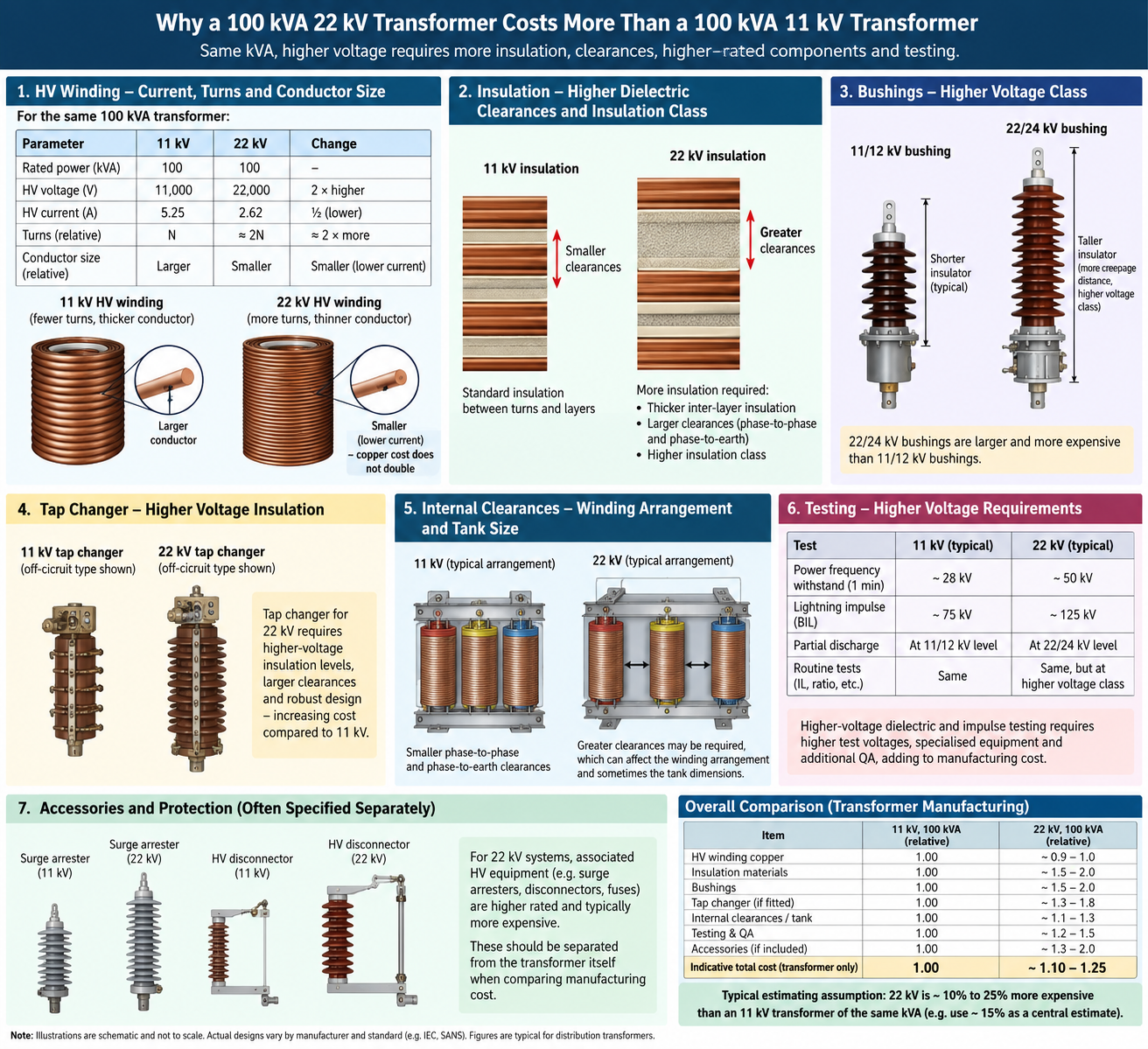
1. Start with the electrical fundamentals
For a three-phase transformer, apparent power is approximately S = √3 × V × I. Holding the rating at 100 kVA means increasing the primary voltage reduces the primary current. At unity-independent kVA calculation, the approximate HV line current is 5.25 A at 11kV and 2.62 A at 22kV.
| Parameter | 100kVA 11kV unit | 100kVA 22kV unit |
|---|---|---|
| Rated apparent power | 100 kVA | 100 kVA |
| HV nominal voltage | 11,000 V | 22,000 V |
| Approx. HV line current | 5.25 A | 2.62 A |
| Relative HV turns | ≈ N | ≈ 2N |
| General HV conductor tendency | Higher current / larger section | Lower current / smaller section possible |
This is important because it explains why the copper cost does not simply double. The 22kV winding needs roughly twice the turns for the same volts-per-turn design, but it carries roughly half the current. The designer can therefore use a smaller conductor cross-section, subject to thermal, mechanical and manufacturing constraints.
2. The HV winding has more turns—but not necessarily twice the copper cost
The transformer designer selects turns, conductor size, current density, flux density and winding geometry as one system. Moving from 11kV to 22kV generally means more HV turns. However, because current falls, the HV conductor can be thinner. The final copper mass depends on mean length of turn, winding dimensions, conductor choice, insulation build and design margins.
That is why multiplying an 11kV transformer price by two is technically unjustified. The magnetic core and LV winding are also serving the same 100kVA output, so major parts of the transformer remain broadly comparable.
3. Insulation is one of the most important cost drivers
Higher voltage increases electrical stress. The 22kV design therefore needs an insulation system appropriate to its voltage class: insulation between turns and layers, barriers between HV and LV windings, clearances to earthed metalwork, creepage paths and suitable insulating oil or solid insulation arrangements.
This can mean additional paper, pressboard, barriers, spacers and more demanding winding geometry. It also consumes physical space. In transformer design, extra insulation is not merely extra material—it can influence the dimensions of the active part and how efficiently the core window is used.
4. 22kV bushings require a higher voltage class
The HV terminals must bring the conductor through the earthed transformer tank without flashover or insulation breakdown. A 22kV network therefore requires bushings suitable for the applicable higher equipment voltage and insulation level compared with an 11kV network.
Higher-rated bushings commonly require longer insulation paths and greater creepage distance. Their price difference becomes more visible on smaller transformer ratings such as 100kVA because accessories represent a meaningful share of the total manufacturing cost.
5. Tap changer design also changes
Distribution transformers commonly provide off-circuit tapping so the voltage ratio can be adjusted to suit network conditions. On the 22kV winding, the tapping arrangement, connections, selector and insulation must withstand the applicable higher voltage stresses.
The number and percentage of taps may be similar, but the insulation coordination and physical design cannot simply be treated as an 11kV component.
6. Internal electrical clearances become more demanding
Transformer designers must maintain adequate separation between energised parts and between energised parts and earth. Increasing the HV class can require larger internal clearances and more deliberate lead routing. Depending on the manufacturer's design, this may affect winding dimensions, core-window utilisation and sometimes the tank or active-part arrangement.
This does not mean every 22kV 100kVA transformer must have a dramatically larger tank than an 11kV equivalent. Manufacturers optimise standard product ranges differently. The point is that the higher voltage introduces constraints that the lower-voltage design does not have to satisfy to the same degree.
7. Testing and quality assurance are part of manufacturing cost
A transformer is not complete merely because it has been assembled. Routine testing verifies characteristics such as ratio, winding resistance, losses and insulation performance, while applicable type or special tests depend on the specification and standard. South African manufacturer ACTOM states that its distribution transformers are manufactured and tested under SANS 780 and IEC 60076 frameworks, with facilities for routine, type and special testing.
For a higher voltage class, dielectric withstand requirements and the associated test equipment, procedures and quality controls become more demanding. The exact test schedule must always be taken from the procurement specification and applicable standard rather than assumed from a generic comparison.
8. Do not confuse transformer cost with the complete 22kV installation cost
This distinction is critical in a BOQ. A transformer-only comparison should not automatically include the surrounding network equipment. A complete 22kV installation may require appropriately rated surge arresters, drop-out fuses or protection, disconnectors, insulators, cable terminations, switchgear, earthing and structural hardware. Those components can widen the installed project cost difference even if the transformer manufacturing premium itself is modest.
For mini-substations the comparison can become even more pronounced because the enclosure incorporates MV switchgear and LV equipment in addition to the transformer. Eskom documentation, for example, recognises medium-voltage miniature substations for systems with nominal voltages of both 11kV and 22kV.
9. What remains broadly similar?
The same 100kVA rating means many fundamental requirements remain comparable: the delivered apparent power, LV output rating where the secondary voltage is unchanged, core power-transfer duty, cooling principle for equivalent designs, tank fabrication concept and a substantial portion of manufacturing labour. These shared elements are another reason the total price does not scale directly with primary voltage.
10. A practical estimating ratio for an 11kV-to-22kV conversion
| Budget scenario | Multiplier applied to comparable 11kV transformer price | Indicative uplift |
|---|---|---|
| Low allowance | 1.10 | 10% |
| Central preliminary estimate | 1.15 | 15% |
| Conservative early-stage allowance | 1.25 | 25% |
For example, if a genuinely comparable 100kVA 11kV transformer is budgeted at R100,000 excluding VAT, a 15% preliminary uplift gives R115,000 excluding VAT for the 22kV unit. This should be replaced by manufacturer or approved supplier pricing before procurement or final tender adjudication.
11. Why actual quotations may differ by much more—or much less
Voltage class is only one pricing variable. Actual quotations can move because of copper and electrical-steel prices, transformer oil or ester fluid, specified loss capitalisation, vector group, impedance, tapping range, temperature-rise limits, inland or coastal environmental requirements, corrosion protection, accessories, quantity, delivery period, local content requirements, factory capacity and exchange-rate exposure.
A 22kV transformer that is a manufacturer's standard high-volume product may sometimes attract a smaller premium than expected. Conversely, a non-standard 11kV specification with special losses or accessories could cost more than a relatively standard 22kV unit. Procurement should therefore compare like-for-like technical schedules rather than voltage labels alone.
12. 11kV and 22kV in the South African distribution context
Both voltage levels are established in South African distribution networks. Eskom describes local distribution through 22kV and 11kV lines, stepping those voltages down through distribution transformers to voltages suitable for customers. The correct voltage is therefore primarily a network-planning and compatibility decision—not a decision that should be made simply because one transformer is cheaper.
For new or modified supplies, network voltage, available point of connection, load, feeder length, voltage regulation, fault levels, protection philosophy, existing utility standards and future development all matter. Eskom's business-connection guidance also notes that technical design and connection cost depend on the scope and required supply.
13. Questions to put into a transformer RFQ
When asking suppliers for comparable prices, state at least the rated power, primary and secondary voltages, phases, frequency, vector group, impedance requirement, tap range, cooling, loss requirements, insulation medium, applicable standards, installation environment, altitude where relevant, corrosion/coating requirements, accessories, termination arrangement and required tests. For tender work, make sure every bidder prices the same technical schedule.
14. The engineering conclusion
A 100kVA 22kV transformer is not more expensive because it supplies more power than a 100kVA 11kV transformer. It is more demanding because the HV side must operate safely at a higher voltage. The lower HV current partly offsets the additional winding turns, while the higher insulation level, bushings, tap-changing arrangement, internal clearances and dielectric requirements tend to push cost upward.
For concept estimates, using an 11kV price multiplied by approximately 1.15 can be a useful working assumption when no 22kV quotation is yet available. For a tender BOQ, procurement or final estimate, obtain a project-specific quotation against the actual transformer specification.
Related engineering resources
Engineering note: This article is educational and intended for preliminary understanding and estimating. Percentage uplifts are indicative estimating assumptions, not published manufacturer price ratios. Transformer selection, insulation levels, testing and procurement specifications should be confirmed against the applicable SANS/IEC requirements, utility standards and manufacturer data for the specific project.